
What Is Energy Transition and Why Does It Matter for India’s Power Infrastructure?
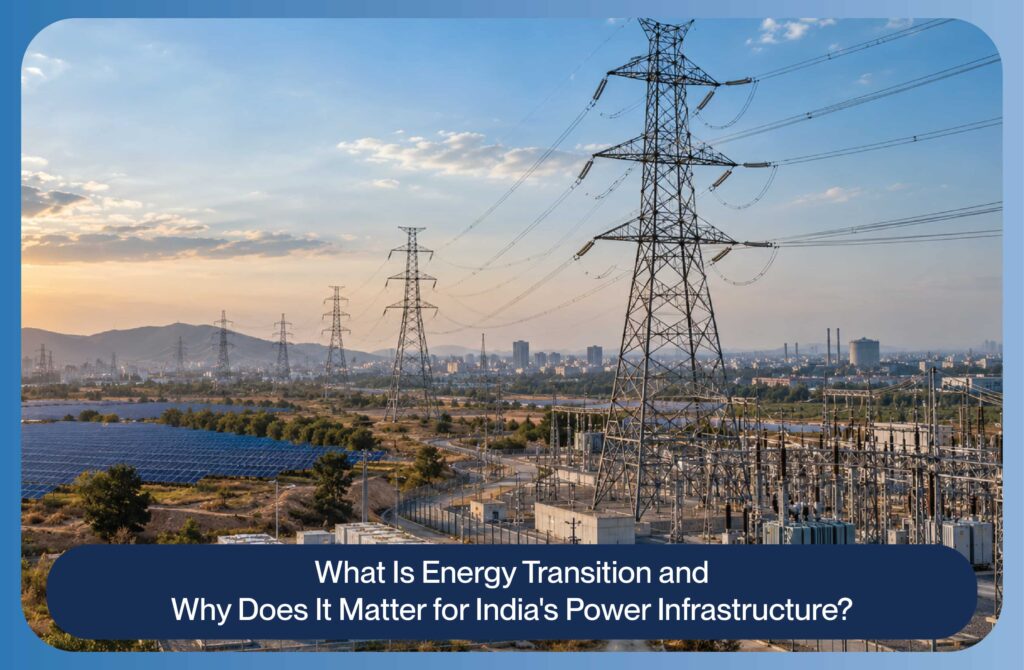
Energy transition is the shift of a power system built on coal, oil and gas towards one built on renewable energy, storage and clean fuels such as green hydrogen. For India, it matters because renewable power is generated in different places and at different times compared with conventional power. That changes what the grid must carry, store and balance. Transmission lines, substations, storage and distribution networks all have to expand and adapt.
Key takeaways
- The transition changes how power is generated, moved, stored and used.
- India crossed the 50% non-fossil installed capacity mark in June 2025, five years ahead of its 2030 target (Ministry of Power).
- A large share of new solar and wind capacity sits far from cities and industries, so new transmission corridors are needed.
- Solar and wind output varies through the day, which makes battery storage a core part of the grid.
- Grid infrastructure sets the pace at which clean capacity reaches consumers.
What Is Energy Transition?
Energy transition is the long-term change in how a country produces and uses energy. In the power sector, it means:
- replacing coal and gas plants with solar, wind, hydro and nuclear
- adding storage to balance supply
- using clean fuels such as green hydrogen in industry
It also changes how the grid is planned and operated. A conventional grid was designed around large thermal plants that run steadily and sit close to coal mines or load centres. A grid built for renewables has to handle three conditions the older grid did not:
- many generators spread across remote areas
- output that rises and falls with the weather
- power that sometimes flows in both directions
| Aspect | Conventional power system | Power system in transition |
| Main sources | Coal, gas, large hydro | Solar, wind, hydro, nuclear, storage |
| Generation pattern | Steady, controllable | Variable, depends on sun and wind |
| Location of plants | Near coal mines or cities | Remote, high-resource areas such as Kutch and western Rajasthan |
| Role of storage | Minimal | Central, for evening peaks and balancing |
| Power flow in distribution | One way, grid to consumer | Two way, with rooftop solar and EV charging |
| Grid planning | Built around a few large plants | Built around many dispersed generators and new corridors |
Where Does India Stand in Its Energy Transition?
India reached 50% of its installed power capacity from non-fossil sources in June 2025, ahead of its 2030 target. As of 30 June 2026, total installed capacity stood at 548.86 GW, with 297.37 GW, or 54.18%, from non-fossil sources, according to the Central Electricity Authority. India’s stated goals are 500 GW of non-fossil capacity by 2030 and net zero emissions by 2070.
Installed capacity and actual generation are different measures. In April to June 2026, thermal plants produced 368 of the 523 billion units generated, about 70%, while renewable energy produced 101 billion units (CEA data). Solar and wind plants generate only when the resource is available. Closing that gap depends less on adding panels and more on the grid’s ability to move, store and balance renewable power.
| Milestone or target | Status |
| 50% non-fossil installed capacity | Achieved in June 2025 |
| 500 GW non-fossil capacity | Target for 2030 |
| Battery storage under Viability Gap Funding | Two existing schemes support 43.8 GWh of battery storage with combined support of ₹9,160 crore. In November 2026 the Cabinet approved a further ₹14,500 crore scheme for 92 GWh of grid-scale storage (30 GWh batteries, 60 GWh pumped storage, 2 GWh other) for FY2026-27 to FY2030-31 |
| Net zero emissions | Target for 2070 |
Why Does Energy Transition Matter for India’s Power Infrastructure?
Renewable energy is only useful if the grid can carry it to consumers. India’s best solar and wind sites are far from demand centres. Their output varies through the day, and distribution networks now handle two-way power flows. Each of these conditions requires new lines, upgrades, storage or controls.
Five pressures stand out:
- Distance. Large renewable parks in Gujarat and Rajasthan need high-voltage corridors to send power to cities and industrial clusters in other regions. Without enough transmission capacity, renewable plants are forced to curtail output.
- Variability. Solar output falls to zero after sunset, as evening demand peaks. Battery storage and flexible grid operation fill that gap.
- Speed. New corridors take years to build. Existing lines are being upgraded with high-capacity conductors, and work is increasingly done on live lines to avoid shutdowns.
- Distribution changes. Rooftop solar, electric vehicles and smart meters mean local networks must handle power flowing back into the grid and far more data.
- Resilience. A grid that carries more critical power must recover faster from cyclones, floods and tower failures.
What Infrastructure Does India’s Energy Transition Need?
India energy infrastructure for the transition falls into six categories:
- new inter-state and intra-state transmission corridors
- upgrades to existing lines
- optical communication for grid control
- large-scale battery storage
- emergency restoration capability
- stronger distribution networks
| Need | Infrastructure | Function |
| Move renewable power over long distances | New 400 kV and 765 kV lines, HVDC corridors, Green Energy Corridors | Connects remote parks with demand centres |
| Increase capacity on existing routes | Re-conductoring with HTLS conductors | Carries more power without new right of way |
| Monitor and protect the grid | OPGW on transmission towers | Provides fibre for protection signalling and SCADA |
| Balance variable output | Grid-scale BESS | Shifts daytime solar to evening peaks |
| Recover from failures | Emergency restoration systems | Restores a line on temporary structures after a tower collapse |
| Modernise local networks | Smart meters and feeder upgrades under RDSS | Reduces losses and accommodates rooftop solar |
The transmission and distribution layers are explained in more detail in our guide to power transmission vs distribution.
What Does an Energy Transition Company Do?
An energy transition company works on both the grid that carries power and the clean technologies that generate, store or convert it. Its work can include:
- transmission products
- battery storage
- electrolysers for green hydrogen
- renewable generation projects
- hydrogen refuelling
Few companies cover every segment. Most combine grid products with one or two clean energy businesses, and the mix determines where in the value chain each company operates.
How Is Advait Positioned in India’s Energy Transition?
Advait Energy Transitions Limited (AETL) manufactures and supplies power transmission products. The company is listed on the BSE and NSE and is headquartered in Ahmedabad, Gujarat.
- Transmission products: OPGW, OFC cable, ACS wire, porcelain and composite insulators, emergency restoration systems, stringing tools, joint boxes, and transmission line hardware and fittings.
- Customers: state transmission utilities, central transmission companies, EPC contractors and private transmission developers.
- Track record: 16 years of operation, 120 plus customers served and 510 plus projects delivered.
- Clean energy: Through group companies, Advait is also active in solar, battery energy storage, green hydrogen and electrolysers.
Its transmission products address two of the six infrastructure needs listed above directly: optical communication through OPGW and emergency restoration through emergency restoration systems. Its ACS wire, insulators, line hardware and stringing tools are used in building new corridors and upgrading existing lines.
Frequently Asked Questions
Is energy transition only about renewable energy?
No. Renewable generation is one part. The transition also includes transmission and distribution upgrades, battery storage, grid digitalisation, electric mobility and clean fuels such as green hydrogen. Without the grid and storage, renewable capacity cannot reliably reach consumers.
What is the difference between energy transition and decarbonisation?
Decarbonisation is the goal of cutting carbon emissions. Energy transition is the process of changing the energy system to reach that goal, including the technologies, infrastructure, policies and markets involved.
Why do renewable projects need new transmission lines?
India’s strongest solar and wind resources are in remote areas such as Kutch and western Rajasthan, far from most demand. New high-voltage lines are needed to carry that power to cities and industries. Without them, plants may be forced to curtail output.
What is the Green Energy Corridor?
The Green Energy Corridor is a government programme to build transmission lines and substations dedicated to evacuating renewable power into the grid. It covers both inter-state and intra-state networks. In September 2026 the Union Cabinet approved Phase III of the scheme, which the Prime Minister described as a big push towards 900 GW of non-fossil capacity by 2035.
How does battery storage support the grid?
Battery storage absorbs surplus solar power during the day and releases it in the evening when demand peaks. It also supports grid frequency when renewable output changes quickly.