
New Renewable Energy in India: Key Technologies Driving the Clean Energy Transition
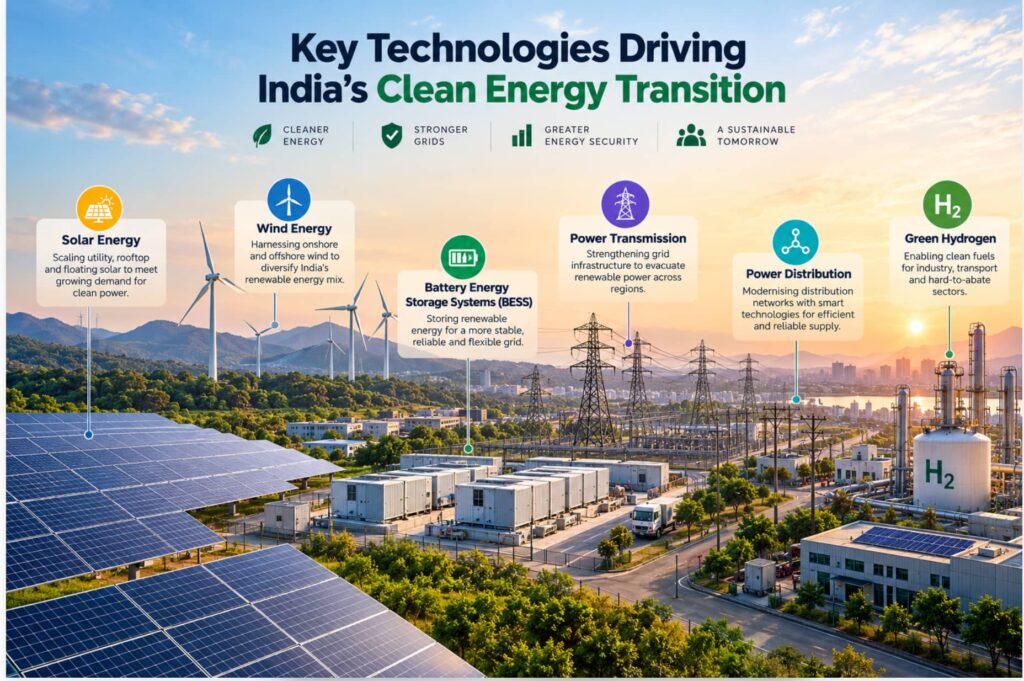
New renewable energy in India rests on four technologies: solar power, battery energy storage, green hydrogen produced through electrolysers, and fuel cells. Solar generates clean electricity at scale. Batteries store it for use after sunset. Green hydrogen and fuel cells carry clean energy into industrial processes and applications that grid electricity cannot serve directly.
Key takeaways
- Solar made up about 81% of the record 55.29 GW of non-fossil capacity India added in 2025-26 (MNRE).
- Battery storage shifts daytime solar output to evening and night demand.
- Green hydrogen can replace fossil-based hydrogen in refining, fertiliser and steel.
- Fuel cells convert hydrogen back into electricity for backup power, microgrids and transport.
- Domestic manufacturing of batteries and electrolysers is a national policy priority.
What Is New Renewable Energy?
New renewable energy (NRE) refers to clean energy technologies beyond conventional large hydro. It covers solar, wind, battery storage, green hydrogen and fuel cells. In India, NRE is the main route to the national target of 500 GW of non-fossil power capacity by 2030, announced by the Prime Minister at COP26 and pursued by the Ministry of New and Renewable Energy.
The term reflects a wider scope than adding solar panels. Power has to be generated, stored, moved and in some cases converted into fuel. Each step depends on a different technology, and each is at a different stage of maturity.
| Technology | Function | Main users in India |
| Solar PV | Generates electricity from sunlight | Utilities, developers, industries |
| Battery energy storage (BESS) | Stores electricity and releases it when needed | State utilities, grid operators, C&I consumers |
| Electrolysers | Split water into hydrogen and oxygen using renewable power | Refineries, fertiliser, steel, chemical plants |
| Fuel cells | Convert hydrogen into electricity | Microgrids, backup power, mobility |
How Is Solar Power Built at Scale in India?
Large solar plants in India are built under EPC contracts. The EPC contractor handles engineering, procurement and construction, then hands over an operating plant to the owner. An EPC company in India typically covers:
- site survey and design
- procurement of modules, inverters and structures
- civil and electrical works
- grid connection and commissioning
For the plant owner, this places responsibility for the full build with one contractor. The scope offered by solar EPC companies in India varies by segment:
- Utility-scale solar: large plants that sell power to state utilities or central agencies, often in high-irradiation regions such as Kutch in Gujarat.
- Commercial and industrial (C&I) solar: plants built for factories and commercial users to reduce grid power costs, under captive, group captive or open access arrangements.
- DREBP in Gujarat: the Distributed Renewable Energy Bilateral Purchase scheme allows smaller solar and wind projects to sell power to state distribution companies at a tariff determined by GERC. Solar projects above 500 kW and up to 5,000 kW (AC), and wind projects above 500 kW and below 10,000 kW, have been eligible (GEDA; confirm current limits).
Why Does India’s Grid Need Storage?
Solar generates only during the day, while demand peaks in the evening. Storage absorbs surplus daytime output and releases it after sunset, which supports grid stability. Most grid-scale projects in India use lithium iron phosphate (LFP) cells, which offer long cycle life and good thermal stability.
| Application | Description | Users |
| Standalone BESS | Batteries connected directly to a grid substation | State utilities, grid operators |
| Solar plus BESS hybrid | Storage paired with a solar plant | Developers, C&I consumers |
| Round-the-clock (RTC) | Renewables plus storage supplying power 24 hours a day | Utilities, large industries |
| FDRE | Firm and dispatchable renewable energy on a fixed schedule | Utilities, power buyers |
| C&I storage | Batteries at factories to reduce peak charges and improve reliability | Commercial and industrial users |
The Government of India supports grid-scale storage through viability gap funding (VGF), which reduces upfront cost for utilities. In Gujarat, GUVNL has run competitive tenders for standalone storage capacity.
Most systems were imported until recently. Domestic BESS manufacturers in India now assemble cells into modules, packs and containerised systems, with a battery management system that monitors each cell.
How Is Green Hydrogen Produced in India?
Green hydrogen is produced by splitting water in an electrolyser powered by renewable electricity. No fossil fuel is used, so the process produces no direct carbon emissions. A green hydrogen company in India may manufacture electrolysers, build hydrogen plants, or supply hydrogen to industrial users.
The National Green Hydrogen Mission, launched in January 2023, aims for 5 million tonnes of green hydrogen a year by 2030. The SIGHT programme, run by SECI, provides incentives for electrolyser manufacturing and green hydrogen production.
| Type | Operating principle | Strength |
| Alkaline | Liquid alkaline electrolyte | Proven, lower cost, suited to large steady loads |
| PEM | Solid polymer membrane | Compact, responds quickly to variable solar and wind output |
Early industrial demand in India comes from replacing grey hydrogen in refineries, fertiliser plants and steel.
What Role Do Fuel Cells Play in Clean Energy?
A fuel cell converts hydrogen into electricity, with water as the only by-product. Fuel cells provide backup power, run off-grid microgrids and can power vehicles and vessels. Paired with electrolysers, they allow renewable energy to be stored as hydrogen and converted back into electricity when required.
Proton exchange membrane (PEM) fuel cells are the most widely used type, because they start quickly and suit both stationary and mobility applications. Early applications in India include microgrids, telecom and data centre backup, and transport pilots.
How Is Advait Greenergy Contributing to New Renewable Energy?
Advait Greenergy Private Limited (AGPL) is a clean energy company in India with its registered office in Ahmedabad. It is a subsidiary of Advait Energy Transitions. It works in solar EPC and battery energy storage for C&I businesses, state utilities and renewable energy developers.
- Solar EPC: as a renewable energy company in Gujarat, AGPL delivers commercial and industrial plants of roughly 100 kW to 1 MW, and utility-scale projects for developers. It has delivered more than 250 MW of solar capacity, with clients including Adani and KP Group.
- Named solar projects: a 67.1 MWp ground-mounted independent power producer project, and a 100 MWac project at Khavda, of which 12.5 MW had been energised by early 2026
- Battery storage projects: the Advait group is developing a 50 MW/100 MWh battery energy storage system at the 220 kV Radhanpur substation for GUVNL, connected at 66 kV, under GUVNL’s Phase IV tender on a build-own-operate basis with Ministry of Power VGF support. Through its subsidiary Advait BESS Bhesaan Private Limited, the group signed a purchase agreement with GUVNL in June 2026 for a 150 MW/300 MWh project under Phase VIII.
- Green hydrogen: AGPL inaugurated a 30 MW alkaline electrolyser assembly facility in Mehsana, Gujarat, with plans to expand to 100 MW in Phase II and 300 MW in Phase III. It has also completed a 1 MW green hydrogen plant in Gujarat.
- Manufacturing: A battery energy storage manufacturing facility in Gujarat, with Phase 1 of 2.5 GWh scheduled for December 2026
Among solar EPC companies in Ahmedabad, AGPL’s scope is limited to commercial, industrial and utility-scale work. It does not install rooftop or residential systems.
Frequently Asked Questions
What are new renewable energy companies in India?
New renewable energy companies in India work on technologies beyond conventional power, such as solar, battery storage, green hydrogen and fuel cells. Some focus on one technology. Others combine EPC, manufacturing and project development across several.
What should a buyer check in a top renewable energy company in India?
Five factors matter most:
- a commissioned project record with named clients
- in-house engineering capability
- control over manufacturing or supply
- compliance with Indian grid and safety standards
- operation and maintenance support after handover
When assessing the best green energy company in India for a specific project, the relevant measure is its record in the technology required, rather than its overall size.
What is the difference between solar EPC and BESS?
Solar EPC is the design and construction of a solar power plant, which generates electricity. BESS is a battery system that stores electricity and releases it later. Many new projects combine both, so solar power can be supplied after sunset.
Is green hydrogen the same as hydrogen fuel?
No. Green hydrogen is produced using renewable energy. Hydrogen fuel can also be made from natural gas or coal, which releases carbon. Under India’s Green Hydrogen Standard, hydrogen is classed as green when it is made through renewable-powered electrolysis or biomass conversion and its well-to-gate emissions do not exceed 2 kg of CO2 equivalent per kg of hydrogen.
Summary
Solar provides the generation base for new renewable energy in India. Storage makes that generation available after sunset, and is moving into procurement at scale through utility tenders and viability gap funding. Green hydrogen and fuel cells extend clean energy into industry and backup power, supported by the National Green Hydrogen Mission. Domestic manufacturing in storage and electrolysers is expanding under national policy. More on AGPL’s solar and storage work is available from Advait Greenergy.