
Power Transmission vs Distribution: What Is the Difference?
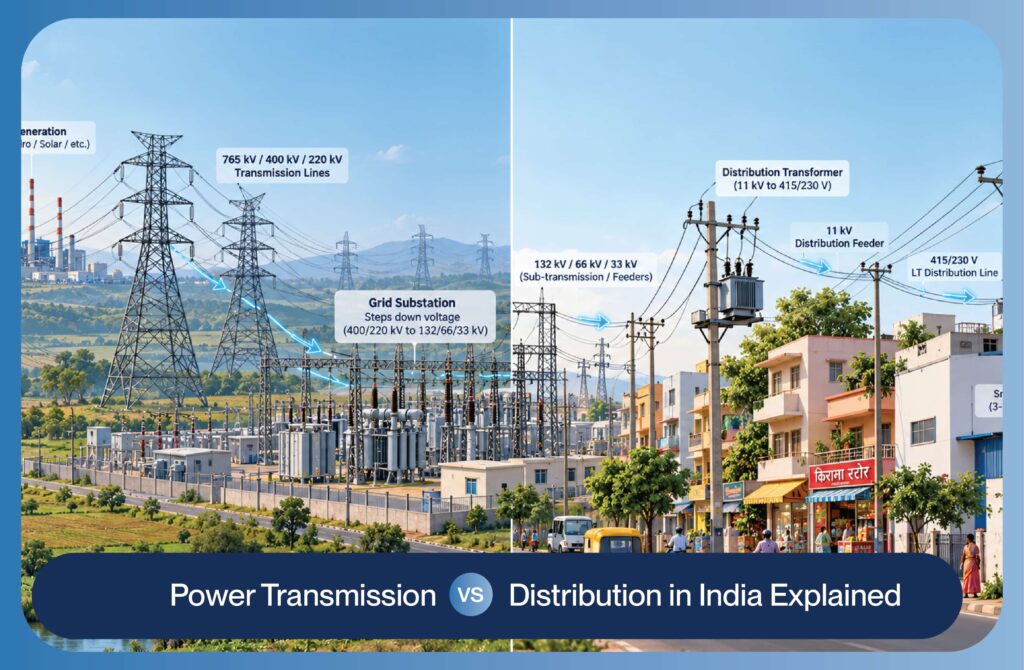
Power transmission carries bulk electricity at high voltage over long distances, between generating stations and grid substations. Power distribution carries electricity at lower voltage over short distances, between local substations and the final consumer. In India, transmission generally means 132 kV and above, up to 765 kV. Some state utilities, including GETCO in Gujarat, also run 66 kV lines as part of their transmission networks. Distribution operates at 33 kV and below. How 66 kV and 33 kV lines are classified varies by state, and they often form an intermediate sub-transmission layer. A power transmission company in India builds, operates or supplies equipment for the high-voltage layer of this network.
Key takeaways
- Transmission moves bulk power over long distances. Distribution delivers it to the end user.
- High voltage reduces resistive losses, which is why transmission runs at 132 kV and above.
- Transmission networks are meshed and built on steel lattice towers. Distribution networks are mostly radial and built on poles.
- Transmission is operated by central, state and private transmission utilities. Distribution is operated by DISCOMs.
- Losses are higher in distribution than in transmission.
What Is the Difference Between Power Transmission and Distribution?
The difference lies in voltage, distance and function. The two networks also differ in layout, equipment, ownership and loss profile.
What is power transmission?
Power transmission is the high-voltage layer of the grid. It carries electricity out of generating stations and into large grid substations, often across state and regional boundaries. The inter-state network is planned centrally. Each state plans and operates its own intra-state network.
What is power distribution?
Power distribution is the lower-voltage layer. It takes electricity from local substations and delivers it to each consumer through feeders, distribution transformers and service lines.
Why is electricity transmitted at high voltage?
For the same power, a higher voltage means a lower current. Resistive loss in a conductor is proportional to the square of the current, so doubling the voltage reduces that loss to one quarter. This is what makes bulk transfer over hundreds of kilometres practical.
The Indian grid uses the following transmission levels, as defined in standards issued by the Central Electricity Authority:
- 765 kV and 400 kV: the backbone of the grid. They typically carry bulk power between regions and states, and are also used by some state utilities.
- 220 kV and 132 kV: typically used to link grid substations with regional substations, mostly within states.
- 66 kV: used by some state utilities, such as GETCO, as part of their transmission network.
- ±500 kV and ±800 kV HVDC: long, high-capacity corridors.
| Parameter | Power transmission | Power distribution |
| Function | Moves bulk power over long distances | Delivers power to end consumers |
| Voltage in India | 765 kV, 400 kV, 220 kV, 132 kV (AC), sometimes 66 kV for state networks; ±500 kV and ±800 kV (HVDC) | 33 kV, 22 kV, 11 kV and 400/230 V (33 kV is treated as sub-transmission in some states) |
| Distance | Hundreds of kilometres, often across states | A few kilometres within a town or rural area |
| Network layout | Meshed, with several paths for power flow | Mostly radial, with one main path to each consumer |
| Structures | Steel lattice towers | Concrete or steel poles |
| Operator | Central and state transmission utilities, private transmission licensees | DISCOMs |
| Supplies | DISCOMs, large industrial consumers, other states | Homes, businesses, farms, factories |
| Losses | Lower, mostly technical | Higher, technical and commercial |
How Does the Distribution Network Deliver Power to Consumers?
The distribution network steps voltage down in stages:
- 33/11 kV substation: power arrives at 33 kV and is stepped down to 11 kV.
- 11 kV feeders: these lines run through a locality, a village cluster or an industrial estate.
- Distribution transformer: mounted on a pole or plinth near the street, it converts 11 kV to low voltage.
- Low-tension supply: 230 V single-phase supplies most homes. 400 V three-phase supplies shops, agricultural pumps and small factories.
Most feeders are radial. A fault on one feeder interrupts supply to every consumer beyond it. This is why a single branch on an 11 kV line during the monsoon can take an entire colony off supply.
Where are losses higher, transmission or distribution?
Losses are higher in distribution, for two reasons. Lower voltage means higher current, and therefore higher resistive loss. Theft, unmetered supply and billing gaps add commercial losses on top.
India’s distribution utilities recorded overall AT&C (aggregate technical and commercial) losses of 15.04% in FY25, down from 15.97% in FY24, according to the 14th Integrated Rating and Ranking of Power Distribution Utilities. The Revamped Distribution Sector Scheme (RDSS) of the Ministry of Power funds smart metering, feeder segregation and network strengthening to reduce these losses
Who Runs Power Transmission and Distribution in India?
The Electricity Act, 2003 treats transmission and distribution as separate licensed activities.
Transmission
- The Central Transmission Utility plans the inter-state transmission system.
- State Transmission Utilities, such as GETCO in Gujarat, operate lines within each state. Their networks often include 66 kV lines alongside 132 kV, 220 kV and 400 kV.
- Private transmission licensees build and own lines awarded through tariff-based competitive bidding.
- Grid-India and the load despatch centres manage grid operation in real time.
Distribution
- DISCOMs own the local network, purchase power and bill consumers.
- Gujarat has four state DISCOMs: UGVCL, DGVCL, MGVCL and PGVCL. Torrent Power holds distribution licences in cities including Ahmedabad and Surat.
The Central Electricity Authority sets technical standards for both networks.
What Does a Power Transmission Company in India Do?
A power transmission company is any business that owns, builds or supplies the high-voltage network. In India, these businesses fall into four types.
| Type | Role | Example |
| Transmission utility | Owns and operates lines and substations | POWERGRID, State Transmission Utilities |
| Transmission developer | Wins lines through competitive bidding, then builds, owns and operates them | Private transmission licensees |
| Transmission line company (EPC) | Designs, builds and commissions lines and substations | EPC contractors |
| Equipment manufacturer | Manufactures conductors, earth wire, cables, insulators, hardware and tools | Manufacturers of OPGW, ACS wire, ERS and stringing tools |
Some firms combine manufacturing and EPC, offering power transmission solutions that cover both products and site execution. A power transmission and distribution company in India works on both layers, for example 400 kV lines for a transmission utility and 11 kV feeders for a DISCOM.
Where Advait Energy Transitions Limited fits
Advait Energy Transitions Limited (AETL) manufactures and supplies power transmission products. The company is listed on the BSE and NSE and is headquartered in Ahmedabad, Gujarat. Its product range covers OPGW, optical fibre cable, ACS wire, porcelain and composite insulators, emergency restoration systems, stringing tools, joint boxes, and transmission line hardware and fittings.
The cable range positions AETL as a cable manufacturer in Gujarat focused on overhead transmission. Its customers are state transmission utilities, central transmission companies, EPC contractors and private transmission developers. Over 16 years of operation, AETL has served 120 plus customers and delivered 510 plus projects.
What Equipment Is Used in Transmission and Distribution Lines?
Transmission lines use steel lattice towers, bundled conductors, long insulator strings and an earth wire on the tower peak. Distribution lines use poles, smaller conductors and short pin or post insulators.
| Component | Transmission | Distribution |
| Structures | Steel lattice towers | PSC or steel poles |
| Conductors | ACSR, AAAC or HTLS, often bundled at 400 kV and above | ACSR, AAAC or aerial bunched cable |
| Earth wire | ACS wire or OPGW on the tower peak | Often absent on LT lines |
| Insulation | Insulator strings in porcelain, glass or composite | Pin-type or post-type insulators |
| Communication | OPGW carries optical fibre for protection signalling and SCADA | Limited, expanding with smart metering |
| Line construction | Tension stringing with pullers and tensioners | Mostly manual stringing |
| Outage restoration | Emergency restoration systems as temporary towers | Pole replacement by local crews |
A transmission failure affects far more consumers than a feeder fault. When a tower collapses during a cyclone, supply can be interrupted across several districts. Emergency restoration systems allow a utility to erect temporary structures and restore the circuit while the permanent tower is rebuilt.
How Do Transmission and Distribution Support Energy Infrastructure in India?
India has set a target of 500 GW of non-fossil power capacity by 2030. The country crossed 300 GW of installed non-fossil capacity by 31 July 2026, according to MNRE. A large share of the new capacity is located in high-resource zones, such as the Khavda renewable energy park in Kutch, far from the cities and industrial clusters that consume the power. High-voltage corridors connect these zones to demand centres. The Green Energy Corridor programme funds transmission built for this purpose, which places transmission at the centre of energy infrastructure in India.
Distribution networks face a different change. Rooftop solar, electric vehicle charging and smart metering introduce two-way power flow and far more data at the feeder level. Feeder strengthening and storage are required to manage both.
AETL operates as an energy transition company. Alongside its transmission products business, Advait is active through group companies in solar, battery energy storage, green hydrogen, alkaline electrolysers and hydrogen refuelling.
Frequently Asked Questions
Which voltage is used for distribution in India?
Primary distribution runs at 33 kV, 22 kV and 11 kV. Distribution transformers then step it down to 400 V three-phase and 230 V single-phase for consumers.
What does a transmission line company in India do?
A transmission line company designs, builds and commissions high-voltage lines and substations for utilities and developers. The scope covers route survey, tower foundations and erection, conductor and earth wire stringing, and testing.
What is sub-transmission?
Sub-transmission is the intermediate layer of the grid, usually at 66 kV or 33 kV. It links large transmission substations with local distribution substations. The voltage used varies by state.
Is a DISCOM a transmission company?
No. A DISCOM is a distribution company. It purchases power delivered through the transmission network and supplies it to consumers through its local network.