
Porcelain vs Composite Insulators: Differences, Applications and Selection Factors
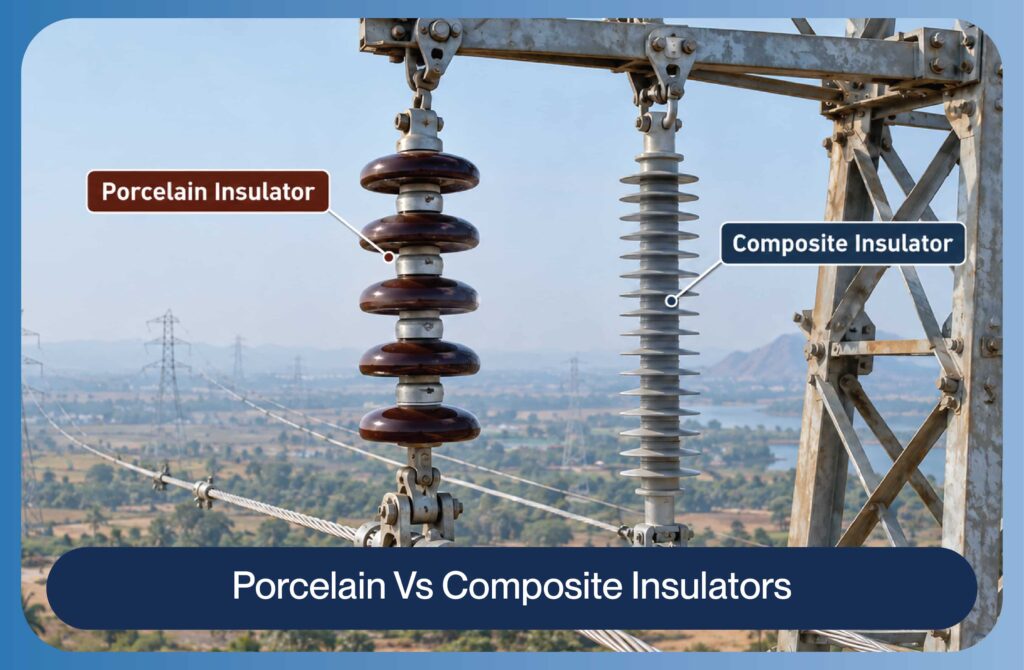
Quick answer: Porcelain insulators are made of fired, glazed ceramic and have the longest service record on power lines. Composite insulators use a fibreglass core inside a silicone rubber housing. This makes them much lighter and better at resisting flashover in polluted areas.
Porcelain suits stable inland sites and substation equipment. Composite insulators suit:
- coastal, desert and industrial zones
- compact lines
- places where vandalism or handling weight is a concern
Key takeaways
- The main difference in porcelain vs composite insulators is the material, which changes weight, pollution performance and how each one fails.
- Composite insulators repel water, so dust and salt are less likely to cause flashover.
- Porcelain insulators do not age under sunlight and have decades of field history.
- Composite insulators need careful handling. At higher voltages they also need grading rings to control electrical stress.
- Selection depends on voltage, mechanical load, pollution level, climate, maintenance access and utility specifications.
What Is a Porcelain Insulator?
Short answer: A porcelain insulator is made from a mix of clay, quartz and feldspar or alumina that is shaped, glazed and fired at high temperature. Metal fittings are cemented to it so it can be attached to the tower and conductor. It is strong in compression, stable under heat and sunlight, and has been used on power lines for more than a century.
The glaze gives a smooth surface that sheds rain and slows down dirt build-up. Porcelain is used for pin, post, shackle and string insulators across all voltage levels.
Its main drawbacks are weight and brittleness. A stone or bullet can chip or crack a unit, and some internal cracks cannot be seen from the ground.
What Is a Composite Insulator?
Short answer: A composite insulator has three parts:
- a fibreglass-reinforced resin rod that carries the mechanical load
- a silicone rubber housing with sheds that provides insulation
- metal end fittings crimped onto the rod
It is also called a polymer or silicone rubber insulator.
Because the core carries the load and the housing handles the electrical stress, each part can be designed for its own job. The result is a long, slim unit that weighs a fraction of an equivalent porcelain string.
Composite insulators are used as:
- suspension and tension long-rod insulators
- line post insulators
- housings for surge arresters and bushings
[Image 1: A porcelain string beside a composite insulator. Alt text: “Porcelain vs composite insulators, porcelain string beside a silicone rubber long-rod insulator”]
Porcelain vs Composite Insulators: Key Differences
Short answer: Porcelain and composite insulators differ in five main ways:
- weight
- surface behaviour in rain and pollution
- resistance to physical damage
- how they age
- how faults are detected
Composite insulators are lighter and perform better in pollution. Porcelain insulators are more resistant to ageing and have a longer track record.
| Factor | Porcelain insulator | Composite insulator |
| Material | Glazed ceramic with cemented metal fittings | Fibreglass rod, silicone rubber housing, crimped metal fittings |
| Weight | Heavy | Much lighter |
| Surface in rain | Water forms a film on the surface | Water forms beads and runs off |
| Pollution performance | Needs washing or extra creepage distance in heavy pollution | Better, as the silicone surface stays water-repellent |
| Physical damage | Can chip, crack or break | Highly resistant to stones and gunshots |
| Ageing | Stable under sunlight and heat | Housing can slowly age from sunlight, corona and electrical discharge on the surface |
| Typical failure | Internal puncture or cracked unit | Surface tracking, erosion, or moisture reaching the core |
| Fault detection | Hidden punctures need testing | Mostly visual and thermal inspection |
| Handling | Robust in transport | Housing can be cut or damaged by rough handling |
| Field history | Over 100 years | Several decades, now widely used |
Why composite insulators handle pollution better
Silicone rubber is hydrophobic, which means water beads up instead of spreading into a film. When dust or salt settles on the surface, small molecules from the silicone move into the dirt layer and make it water-repellent too. This keeps leakage current low and reduces flashover during fog, dew and the first rains after a dry spell.
On porcelain, a wet layer of dirt conducts current more easily. Utilities in polluted areas therefore often wash porcelain insulators, or fit units with a longer creepage distance (the length of the path along the surface between the live end and the earthed end).
How each type fails
Porcelain usually fails through a puncture inside the unit or a crack from impact or thermal stress. A punctured unit can look normal, so utilities use testing to find it.
Composite insulators rarely break from impact, but the housing can wear through tracking and erosion over time. If moisture reaches the fibreglass core through a damaged housing or a poor seal at the end fitting, the rod can weaken. This is why the quality of the housing and the end-fitting seal matters so much.
Where Are Porcelain and Composite Insulators Used?
Short answer: Porcelain insulators are widely used in substations, on inland lines with low pollution, and wherever utilities prefer long-proven designs. Composite insulators are preferred:
- near the coast and in deserts
- near industry
- on compact or uprated lines
- in areas prone to vandalism
| Application | Porcelain | Composite |
| Substation station posts and heavy equipment | Common choice | Used for some equipment housings |
| Inland lines with low pollution | Well suited | Suitable |
| Coastal areas with salt deposits | Needs washing or extra creepage distance | Well suited |
| Desert and dusty areas such as Kutch and western Rajasthan | Needs frequent cleaning | Well suited |
| Lines near cement, chemical or thermal plants | Higher flashover risk | Well suited |
| Areas with vandalism or stone throwing | Prone to damage | Well suited |
| Compact lines and line uprating | Heavier strings limit design | Light weight and slim profile help |
| Areas with heavy bird activity | Not affected by pecking | Housing can be damaged by some birds |
In India, the choice often follows geography. Lines through coastal Gujarat, Tamil Nadu and Odisha, or past large industrial clusters, face higher pollution flashover risk. Lines in cleaner inland regions often continue with porcelain.
Selection Factors for Porcelain and Composite Insulators
Short answer: The main selection factors are:
- system voltage
- mechanical load
- site pollution severity
- climate
- maintenance access
- total cost over the insulator’s life
- the utility’s technical specification
No single material is right for every line.
- System voltage and insulation level. The insulator must withstand normal voltage, switching surges and lightning impulses.
- Mechanical load. Porcelain units are rated by their electromechanical failing load. Composite insulators are rated by their specified mechanical load (SML). Both must cover conductor weight, wind and tension with a safety margin.
- Pollution severity. IEC 60815 sets site pollution classes from very light to very heavy. The higher the class, the longer the creepage distance needed, and the stronger the case for composite insulators.
- Climate and sunlight. High heat, strong sunlight and heavy rain affect how silicone ages. Porcelain is unaffected by sunlight.
- Maintenance access. Lines in remote or difficult terrain benefit from insulators that need less washing and are easier to carry and install.
- Grading rings. At higher transmission voltages, composite insulators need grading or corona rings to control electrical stress at the ends. These must be specified and fitted correctly.
- Lifecycle cost. Compare purchase price, transport, installation, washing and replacement over the expected life, not purchase price alone.
- Standards and approvals. Porcelain is tested to IS 731 and IEC 60383. Composite suspension and tension insulators are tested to IEC 61109, with material tests under IEC 62217.
What about coatings and hybrid insulators?
Utilities can coat existing porcelain insulators with room temperature vulcanising (RTV) silicone to give them a water-repellent surface. This is a common way to improve pollution performance on substations and lines without replacing the insulators.
Hybrid insulators, with a porcelain core and a silicone rubber housing, combine porcelain’s rigidity with silicone’s surface behaviour.
How AETL Supports Insulator Selection
Advait Energy Transitions Limited (AETL) supplies porcelain and composite insulators, along with glass insulators and transmission line hardware [CONFIRM: which insulator types AETL manufactures in-house versus supplies]. Its customers are utilities, EPC contractors and private transmission developers. Insulators can be specified alongside other line products such as OPGW and ACS earth wire as part of a complete line package.
Frequently Asked Questions
Are polymer and composite insulators the same?
Yes. The terms are used interchangeably. “Composite” refers to the combination of a fibreglass core and a polymer housing, usually silicone rubber.
Which lasts longer, porcelain or composite insulators?
Porcelain has the longer proven service life, with units in service for many decades. Modern composite insulators have a shorter field history. Well-made units from qualified suppliers are now expected to serve for decades when correctly specified and installed.
Why do composite insulators need grading rings?
At higher voltages, the electric field is concentrated near the metal end fittings. Grading rings spread this field more evenly. This prevents corona discharge from damaging the silicone housing and the seal at the end fitting.
Can a porcelain insulator be upgraded for polluted areas?
Yes. Porcelain insulators can be coated with RTV silicone, which gives the surface water-repellent properties similar to a composite insulator. The coating needs periodic inspection and may need reapplying over time.
Are composite insulators cheaper than porcelain?
The purchase price depends on voltage, rating and order size. Composite insulators often reduce transport, installation and washing costs. Compare the two on total lifecycle cost rather than unit price.
Summary
Porcelain and composite insulators do the same job in different ways.
- Porcelain: heavy, rigid, unaffected by sunlight and backed by more than a century of use.
- Composite: light, water-repellent and resistant to impact, which suits polluted, coastal and vandalism-prone areas. It needs careful handling and correct end fittings.
The right choice comes from matching voltage, mechanical load, pollution severity, climate and lifecycle cost to the site. For product specifications, see AETL’s insulators page.